VietCredit’s Q1 2026 financial report shows it continues its strong growth momentum with after-tax profit reaching VND 461.5 billion, more than six times higher than the same period last year, clearly reflecting the quality of assets, operational efficiency, and sustainability of its growth model.
VietCredit General Finance Joint Stock Company (VietCredit, UPCoM stock code: TIN) has just announced its Q1 2026 financial report with many positive growth indicators, continuing the strong recovery from 2025.
According to the published financial report, VietCredit’s after-tax profit in Q1 2026 reached VND 461.5 billion, more than six times higher than VND 75.8 billion in the same period last year. This is a remarkable growth rate in the context of a consumer finance market that is still undergoing strong differentiation, forcing financial institutions to simultaneously pursue growth targets, control risks, and optimize operational efficiency.
A notable point in VietCredit’s Q1/2026 results is that its profits did not come from extraordinary income, but were mainly driven by core business activities, especially the strong growth in net interest income.
Net interest income increased by over 330%, continuing to be the main growth driver.
In Q1/2026, VietCredit’s net interest income reached VND 1,771 billion, an increase of 330.27% compared to VND 412 billion in the same period of 2025. This was the biggest driver contributing to profit growth during the period, and also showed a significant improvement in the efficiency of exploiting income-generating assets.
According to the company’s explanation, this growth came from the continued strong expansion of loan balances, especially in the digital lending product group. As of March 31, 2026, VietCredit’s total outstanding loan balance reached VND 17,091 billion, a 262% increase compared to the same period last year. Interest income from lending activities in the first quarter alone reached approximately VND 1,576 billion, a 256.84% increase compared to the same period.
This development shows that VietCredit’s profit growth is coming from its core business activities, rather than relying on non-operating income or one-time factors. In the context of an increasingly competitive consumer finance market, this is an important indicator reflecting the quality of growth and the sustainability of profits.
Expansion of scale comes with increased costs, but operational efficiency continues to improve.
Alongside the strong growth in outstanding loans, VietCredit also recorded increased cost pressure in the first quarter, mainly due to the expansion of its operations.
Specifically, net losses from service operations increased from VND 75.4 billion to VND 313.4 billion. According to the company, the main reason is the operating costs and service fees paid to partners in the digital lending segment. In Q1 2026 alone, these costs amounted to VND 305.6 billion, a 342.52% increase compared to the same period last year.
However, these are costs that VietCredit proactively recorded during the expansion phase of its digital lending model, reflecting the specifics of its growth strategy based on the digital distribution ecosystem. In other words, the increase in costs coincided with an increase in disbursement volume, rather than arising from a decline in operational efficiency.
On the operational side, total operating expenses in Q1 2026 reached VND 97.6 billion, a 10.14% increase compared to the same period last year. This increase mainly stemmed from the company adding personnel and investing in operational capacity to meet the new growth scale. Compared to the growth rate of net interest income, this increase in operating expenses remains low, indicating improving operational efficiency.
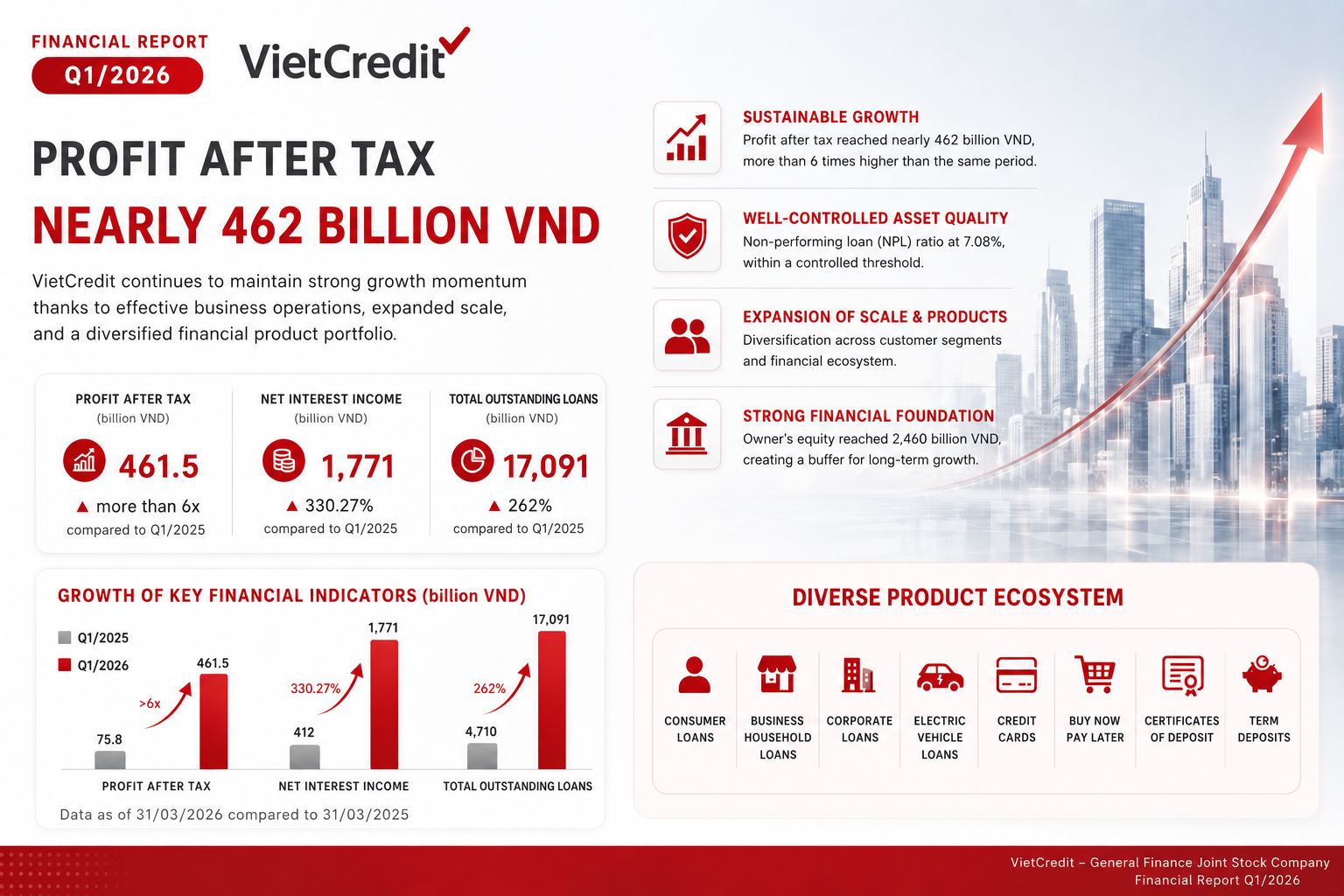
Image: Illustration of the Q1/2026 financial report of VietCredit General Finance Joint Stock Company (VietCredit, UPCoM stock code: TIN)
Increased provisioning according to scale, credit quality remains under control
In Q1/2026, VietCredit’s credit risk provisioning costs increased to VND 518.2 billion, higher than the same period last year. However, this increase is still lower than the growth rate of outstanding credit.
This is significant because it shows that even though the company proactively increased provisions according to the scale of credit growth and complied with provisioning requirements, asset quality is still being controlled at a reasonable level.
As of March 31, 2026, VietCredit’s non-performing loan (NPL) ratio was 7.08%, a slight increase compared to the end of the previous year, but still within controllable limits and consistent with the characteristics of the company’s consumer credit portfolio. Some specific products have low NPLs, such as loans to household businesses and SMEs (NPL 1.39%), and loans for electric vehicle purchases (NPL nearly 0%).
In the context of many finance companies still dealing with old debt burdens or scaling back growth to control risk, VietCredit’s ability to both expand its scale and maintain NPLs within controllable limits demonstrates its strengthening risk management capabilities and growth quality.
Expanding the multi-product digital finance ecosystem
Besides strong business growth, the first quarter of 2026 also marked a period of continued expansion of VietCredit’s operations and diversification of its financial product ecosystem.
In the lending segment – its area of strength – VietCredit continued to launch and expand many products in collaboration with major technology partners such as Tin Vay consumer loans on ZaloPay, Tin Vay PayDay (small short-term loans) in partnership with Zalo, and Tin Vay Biz for corporate customers of FAST Accounting software. At the same time, VietCredit also began to promote its own ecosystem products with Tin Vay Plus – a consumer loan product directly integrated into the VietCredit application, targeting customers within the VietCredit ecosystem without relying on external partner platforms.
In addition to focusing on lending, VietCredit is now also known in the market for other attractive financial segments such as digital credit cards, buy now pay later (BNPL), and capital mobilization. According to the company’s plan, a series of digital credit card products and a buy now, pay later model in collaboration with major partners are also being prepared for launch in the near future, demonstrating VietCredit’s direction to expand into a multi-product, multi-touchpoint digital financial ecosystem.
In particular, in the capital mobilization segment, VietCredit is simultaneously implementing offline and online products through Certificates of Deposit and Time Deposits for businesses, organizations, and households with legal status, offering competitive interest rates of up to 9.9% per year.
Strengthening the Foundation for 2026 Growth Targets
As of March 31, 2026, VietCredit’s total assets reached VND 19,496 billion, an increase of over 10.5% compared to the end of 2025. Equity reached VND 2,460 billion, while undistributed profits increased sharply to nearly VND 1,493 billion, creating further room for growth in subsequent quarters.
The Q1/2026 results show that VietCredit is entering a new growth phase with a healthier profit structure, relying more on core operations, improved asset quality, and enhanced operational efficiency.
In the context of the consumer finance industry continuing to restructure after a period of consolidation, these results not only reflect VietCredit’s own recovery momentum but also show positive signals from a financial model shifting towards digitalization, better risk control, and greater long-term sustainability.