At the end of the second quarter of 2026, VietCredit recorded pre-tax profit of nearly VND 472 billion, an increase of 230% compared to the same period last year. For the first six months of the year, the company’s pre-tax profit exceeded VND 1,049 billion, amidst continued strong growth in loan balances and income from core business operations.
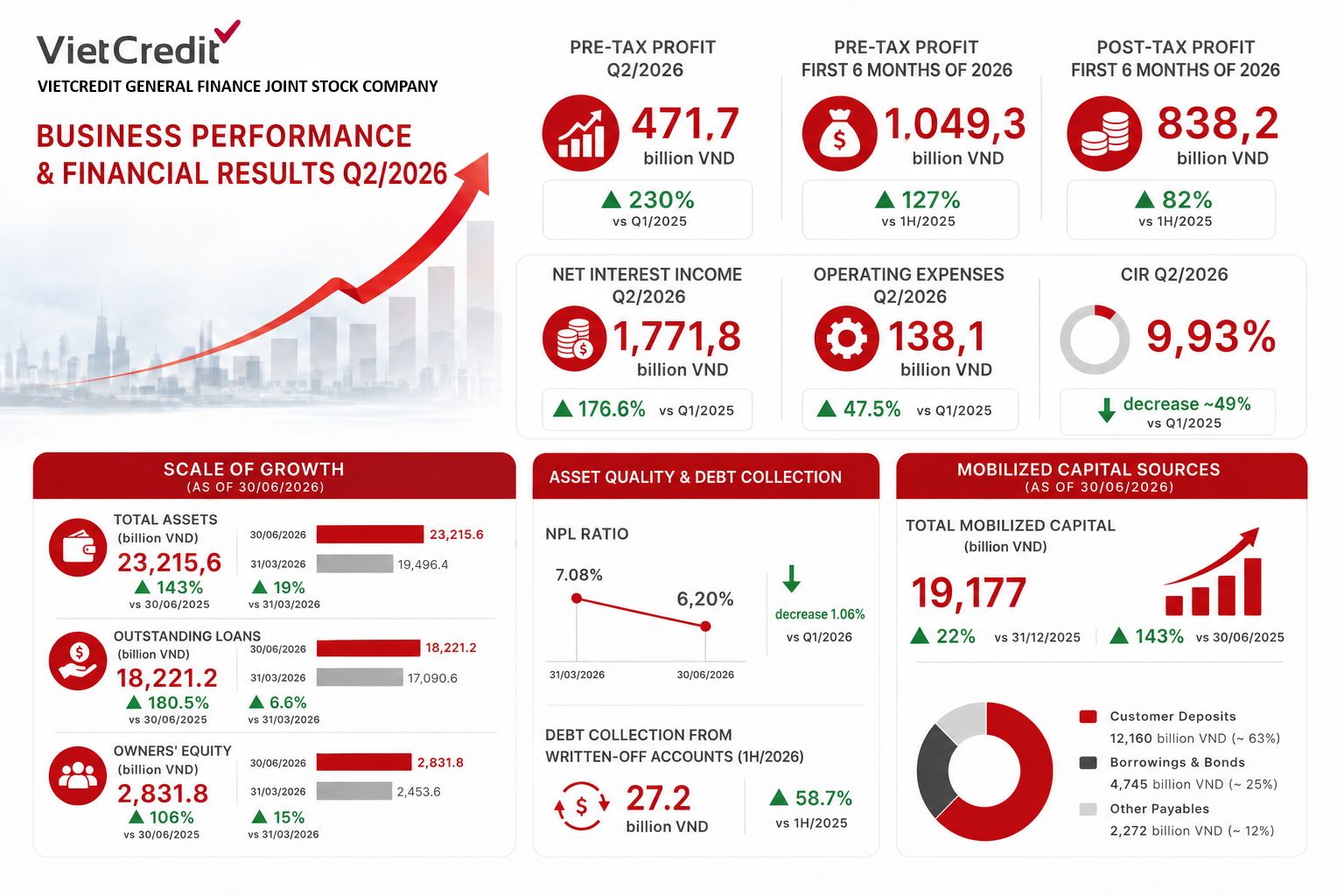
According to the Q2/2026 financial report recently released by VietCredit Joint Stock Company (VietCredit, stock code: TIN) on July 20, 2026, pre-tax profit for Q2 alone reached VND 471.7 billion, an increase of 230% compared to the same period (Q2/2025), achieving 103% of the planned target.
After deducting taxes, second-quarter profits reached VND 376.6 billion, an increase of over 80% compared to VND 208.9 billion in the same period last year.
For the first six months of 2026, VietCredit recorded pre-tax profit of VND 1,049.3 billion and after- tax profit of VND 838.2 billion. This result shows that the company maintained a high profit level after achieving an after-tax profit of VND 461.5 billion in the first quarter.
Net interest income increased by nearly 177%, primarily driven by core operations.
A notable point in the Q2 business results is the strong increase in net interest income. During the quarter, this figure reached approximately VND 1,771.8 billion, a 176.6% increase compared to VND 640.6 billion in the same period of 2025. This continues to be the largest contributor to business results, significantly offsetting credit risk provisioning costs and service fees incurred during the expansion of digital credit operations.
Overall, in the first half of the year, VietCredit’s interest income and similar revenue reached over 3,876 billion VND, more than three times higher than the same period last year.
According to the company’s explanation, the improvement in profitability mainly came from core business operations, especially interest income, thus showing that the quality of revenue sources has shifted towards greater stability and sustainability.
Alongside income growth, service fees have increased as VietCredit expands its Digital Lending model through platform partners. These primarily include operating costs, collection fees, and partner-share expenses, fluctuating proportionally with the disbursement volume and transaction number.
Credit risk provisioning costs in the second quarter reached approximately VND 780.7 billion, a significant increase compared to the same period last year. According to VietCredit, the increase in provisions reflects the rapid expansion of its digital loan portfolio (credit outstanding has increased by nearly 181% in just one year). The company continues to classify loans and make provisions in accordance with regulations.
The loan-to-income ratio (CIR) decreased to 9.93%, the non-performing loan ratio declined, and debt recovery efficiency improved.
One of the most positive indicators in the second quarter was the cost-to-income ratio, or CIR, which fell to 9.93% , approximately 49% lower than the same period last year.
While total operating income increased significantly, operating expenses in the second quarter were only VND 138.1 billion, a 47.5% increase compared to the same period last year. The rate of increase in expenses was significantly lower than the rate of increase in income, resulting in a marked improvement in operational efficiency.
This development reflects the platform partners’ ability to leverage their customer ecosystems and demonstrates the effectiveness of applying AI, big data, efficient service operation and management based on big data, and modern fintech technologies. This significantly reduces operating costs and improves the efficiency of customer assessment and management.
Furthermore, the Non-performing Loan Ratio (NPL) reported by VietCredit in its explanatory report dated June 30, 2026, was 6.02% , a decrease from 7.08% at the end of Q1/2026. Thus, this ratio has improved, decreasing by approximately 1.06 percentage points in one quarter.
Debt recovery efficiency has improved: Recovery from risk-managed debts in the first six months of 2026 reached VND 27.2 billion, an increase of 58.7% compared to the same period in 2025, indicating that off-balance sheet debt recovery is becoming more effective.
Total assets exceeded VND 23.2 trillion, more than 2.4 times higher than the same period last year.
As of June 30, 2026, VietCredit’s total assets reached nearly VND 23,216 billion , an increase of approximately VND 3,719 billion, equivalent to 19%, compared to the end of the first quarter of 2026.
Compared to June 30, 2025, when total assets were only approximately VND 9,536 billion, the company’s asset size has increased by nearly 143%.
The main driver of growth came from outstanding customer loans. By the end of the second quarter, outstanding loans reached over VND 18,221 billion , an increase of 6.6% compared to the end of the first quarter and a 180.5% increase compared to the same period last year.
Of this, loans to individual customers and private enterprises accounted for approximately 93.6% of the total portfolio. Loans to economic organizations reached over VND 1,161 billion, a significant increase compared to the end of 2025, reflecting the direction of gradually expanding into the segments of household businesses, traders, and enterprises.
Equity capital at the end of June reached over VND 2,831 billion, an increase of approximately 15% compared to the end of the first quarter and more than double that of the same period last year. Undistributed profits reached nearly VND 1,668 billion, creating additional capital for business operations in the next phase.
Capital sources are growing, and the structure of fundraising is shifting towards more stable maturities.
Along with the increase in assets, VietCredit’s mobilized capital has also expanded significantly.
Total capital from deposits, loans from credit institutions, customer deposits, and issuance of securities at the end of the second quarter reached approximately VND 19,177 billion , an increase of over 22% compared to the end of 2025 and about 143% higher than the same period last year.
Notably, certificates of deposit reached over VND 12,160 billion, nearly double the level at the end of 2025, becoming the largest source of funding. This increase in the proportion of certificates of deposit helps VietCredit gradually extend the maturity of its funding sources, reduce its dependence on the interbank market, and improve its ability to balance the maturity of deposits with the maturity of loans.
In the second quarter, average deposit interest rates tended to increase in line with general market developments. However, internal reports indicate that actual capital costs remained lower than planned, while capital business activities generated additional revenue beyond lending activities.
Digital platforms continue to contribute to overall growth.
In the second quarter, digital finance projects continued to be a highlight of VietCredit’s operations.
VietCredit continues to expand its ecosystem of digital financial products across multiple segments: individuals, household businesses, and enterprises.
In the personal loan segment, VietCredit continues to strengthen its partnerships with major existing partners (MoMo, Zalo, ZaloPay, Viettel Money, VNPT, Grab), launching new product lines such as short-term loans like Tin Vay PayDay and independent VietCredit products like Tin Vay Plus within the VietCredit app.
VietCredit also provides loans for individual customers to purchase electric cars, and loans for ride-hailing drivers to purchase electric motorbikes. This is a “green credit” service that VietCredit is offering in collaboration with the government to promote environmentally friendly transportation.
For household and business customers, VietCredit not only continues to maintain its lending partnerships with MISA, KiotViet, and FAST Accounting, but also expands into capital mobilization with online term deposits offering attractive interest rates up to 9.9% per year without any minimum deposit amount requirements.
In the credit card segment, VietCredit is maintaining its existing card portfolio while preparing to launch digital card products in partnership with major companies. Simultaneously, in the coming quarter, it plans to roll out new payment features such as VNPAY-QR, VietQRPay NAPAS, and credit limit transfer.
One area where VietCredit has made significant progress is Buy Now Pay Later (BNPL). Currently, VietCredit is the first and only TikTok PayLater partner in the Vietnamese market, with impressive growth in the BNPL product race.
These changes reflect a shift in direction from individual credit products to an integrated digital financial ecosystem. Through this, VietCredit is actively contributing alongside businesses to promote the GPP (Good Banking Practice) of the overall economy, gradually eliminating illegal lending, and bringing credit closer to a wider range of customers who do not meet banking standards.
The next challenge: balancing the speed and quality of growth.
Overall, the business results for the first six months of 2026 show that VietCredit is simultaneously maintaining two important factors: high growth rate (total assets, outstanding loans, and net interest income all grew by two to three percent) and improved operational efficiency (CIR decreased significantly, and loan quality was better controlled each quarter).
Total assets, outstanding loans, and interest income all increased significantly, while the CIR was brought below 10%. The decrease in the non-performing loan ratio compared to the first quarter, the rapid growth of core income, and the shift of capital to more stable maturities are also positive signs.
With outstanding loans exceeding VND 18,200 billion, total assets exceeding VND 23,200 billion, and an increasingly diversified capital structure, VietCredit continues to consolidate its position among the fastest-growing consumer finance companies in the market, amidst increasing competition in the consumer finance industry.
In the second half of 2026, VietCredit’s performance will depend on its ability to continue expanding its disbursement scale while maintaining credit discipline, optimizing partner costs, and controlling the quality of each customer segment.